
Bombay Hook National Wildlife Refuge in Delaware was the fourth national site commemorated in 2015 with a United States quarter design. It is the 29th release of 56 scheduled in the United States Mint series of America the Beautiful Quarters. The quarter program kicked off in 2010 and lasts until at least 2021 when all designated national parks and nationals sites are honored.
There are several key dates for Delaware’s 2015 Bombay Hook Quarter. They include:
- its release into general circulation on Sept 14, 2015;
- its official launch ceremony by the U.S. Mint and the U.S. Fish and Wildlife Service on Sept. 18, 2015; and
- its release in U.S. Mint-branded rolls and bags at www.usmint.gov on Sept 30, 2015.
Every year, five quarters are issued as a part of the program of America the Beautiful Quarters. Each bears a unique reverse image emblematic of a selected national park or national site. They share the same obverse or heads side design showing the familiar John Flanagan portrait of George Washington.
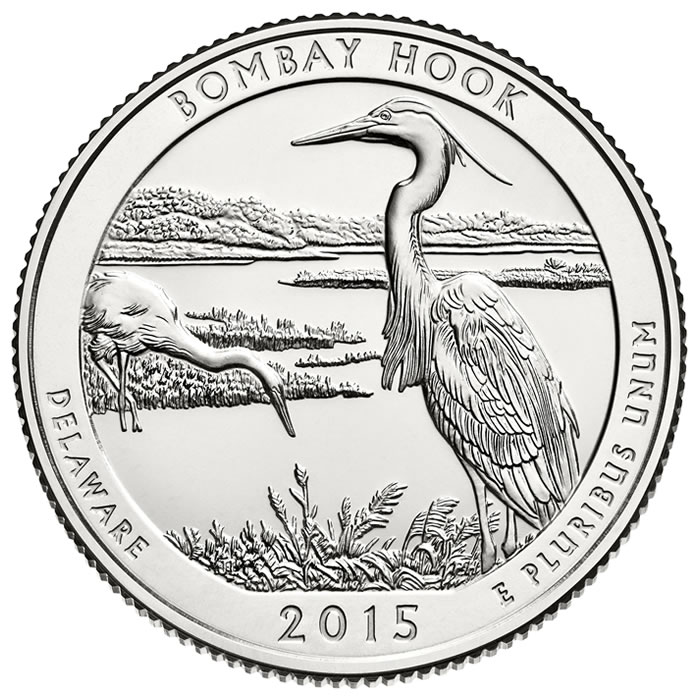
Joel Iskowitz designed and Phebe Hemphill sculpted the reverse or tails side of the Bombay Hook Quarter. This design was selected from among 8 candidates. It features a great blue heron in front and a great egret behind it. Both are seen in the midst of the refuge’s tidal salt marsh. Surrounding the scene are inscriptions of BOMBAY HOOK, DELAWARE, E PLURIBUS UNUM and 2015.
Three 25-cent pieces launched ahead of the 2015 Bombay Hook Quarter. Those quarters are the Homestead National Monument Quarter (NE), the Kisatchie National Forest Quarter (LA), and the Blue Ridge Parkway Quarter (NC). The last quarter for 2015 commemorates Saratoga National Historical Park (NY).
Bombay Hook National Wildlife Refuge Information
Bombay Hook National Wildlife Refuge of Delaware has had many names for the area it encompasses. The Native American’s had called it Canaresse, while others had called it Ruyge-Bosje. Today, Bombay Hook is a play on the Dutch term "Bompies Hoeck," which means "little tree point."
The area is home to a variety of migrating birds, which the wildlife refuge strives to protect. These birds make their home in a tidal salt marsh, which contains nutrient rich water flows. The water flows help keep native foliage alive, providing homes for many of the animals in the area.
Around 100,000 visitors come each year to take part in bird watching, a 12-mile auto tour, photography, hiking and other activities. Tourists may also visit the Allee House, which was a pre-revolutionary war farmhouse. It is listed in the National Register of Historic Places, and remains nearly in its original state.