
The final U.S. quarter for 2016 commemorates Fort Moultrie (Fort Sumter National Monument) in South Carolina. It is the 35th release as part of the U.S. Mint program of America the Beautiful Quarters®. This series started in 2010 and lasts until 2021, honoring 56 unique national parks, memorials or other sites in the United States and its territories.
Here are some important dates and events for South Carolina’s 2016 Fort Moultrie Quarter:
- its release into general circulation on November 14, 2016;
- its availability in U.S. Mint-branded rolls and bags at www.usmint.gov, also on November 14, 2016; and
- its official launch ceremony by the U.S. Mint and the National Park Service at the site on Thursday, November 17, 2016 at 10:30 a.m. ET.
United States Mint forums precede launch ceremonies, offering the public a chance to talk to Mint official about current and upcoming coins and products. The forum is held on November 16 from 6 to 7 p.m. at the Fort Moultrie Visitor Center. In addition, there are coin exchanges right after launch ceremonies. They offer the public an opportunity to swap cash for $10 rolls of new quarters.
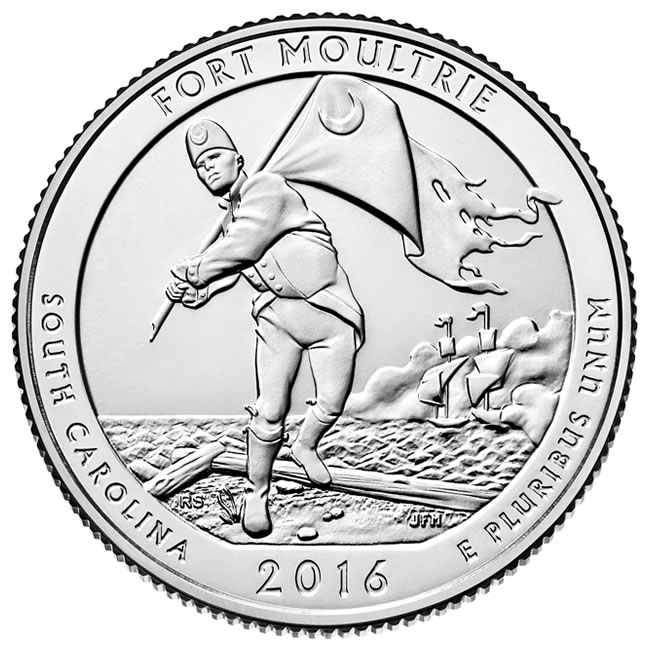
Richard Scott designed and Joseph Menna sculpted the reverse (tails side) of the Fort Moultrie Quarter. It was selected from among seven candidate designs and depicts Sergeant William Jasper returning the regimental flag to the ramparts while under attack from a British ship. Surrounding the design are inscriptions of FORT MOULTRIE, SOUTH CAROLINA, 2016 and E PLURIBUS UNUM.
Quarter obverses (heads side) share the same portrait, an effigy of George Washington as designed by John Flanagan. Inscriptions around the image include UNITED STATES OF AMERICA, LIBERTY, IN GOD WE TRUST, QUARTER DOLLAR, and a letter or mintmark denoting which U.S. Mint facility made it.
Both obverse and reverse designs are also on a series of U.S. Mint bullion and collector 3-inch diameter, 5-ounce silver coins.
The four earlier released 2016 quarters commemorate Shawnee National Forest in Illinois, Cumberland Gap National Historical Park in Kentucky, Harpers Ferry National Historical Park in West Virginia, and Theodore Roosevelt National Park in North Dakota.
Fort Moultrie (Fort Sumter National Monument) Information
Fort Moultrie of South Carolina was named after William Moultrie, who was the commander at the yet to be finished fort when the British attacked in 1776. The fort was made of soft palmetto logs that helped absorb most of the damage from British warships. After nine hours of battle, the British gave up and retreated.
Fort Moultrie eventually became disused and became a part of the larger Fort Sumter. When visitors go to Fort Moultrie today, it is mostly Fort Sumter National Monument.
There is a long and interesting history with Fort Moultrie, as it was constructed and rebuilt multiple times before becoming part of Fort Sumter.