
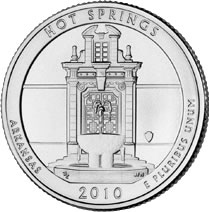
Starting off the America the Beautiful Quarters Program is a design emblematic of the first land set aside by the United States for public use. Today, the area is known as Hot Springs National Park and it is located in the state of Arkansas.
The final design for the 2010 Hot Springs National Park Quarter from Arkansas was announced by the US Mint on March 24, 2010. The coin will be issued for circulation on April 19, 2010, by distribution from the Mint to the Federal Reserve banking system to local banks.
The quarter’s reverse design, shown above, was created by Don Everhart and sculpted by Joseph Menna. It features the park’s headquarters building in the background with a fountain in the foreground. Also shown to the right of the headquarter’s door is the National Park Service (NPS) emblem.
The design was selected by U.S. Secretary of the Treasury Tim Geithner after receiving advice from US Mint Director Ed Moy. In the running were a total of four design candidates (See design candidates below.)
Prior to Mr. Geithner making a selection, two organizations charged with reviewing American coinage designs forwarded their suggestions. The first of the organizations is the United States Commission of Fine Arts which was established in 1910. The second is the Citizens Coinage Advisory Committee which was only authorized by Congress in 2003.
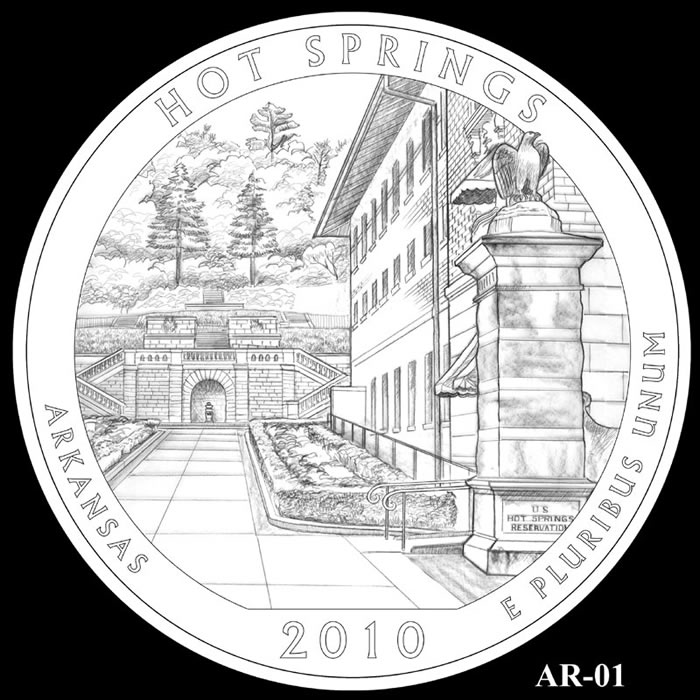
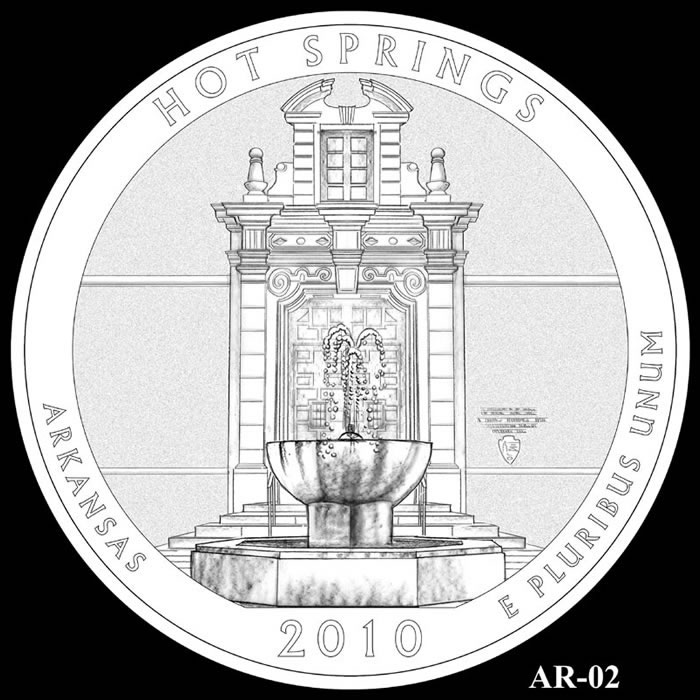
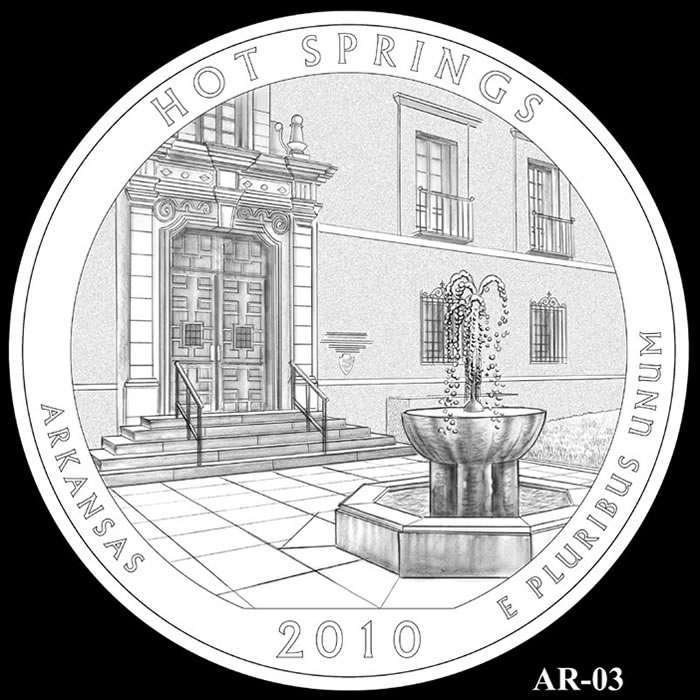
For reference, the original four proposed designs and the CFA and CCAC recommendations follow (the final design chosen was based on AR-02):
 |
 |
 |
 |
Four design candidates were given to each group with the one known as AR-02 being favored by the Commission. It features a fountain in front of the doorway into the Park’s main building. The Commission did comment on the quality of the drawings and made a suggestion for the removal of the park service sign.
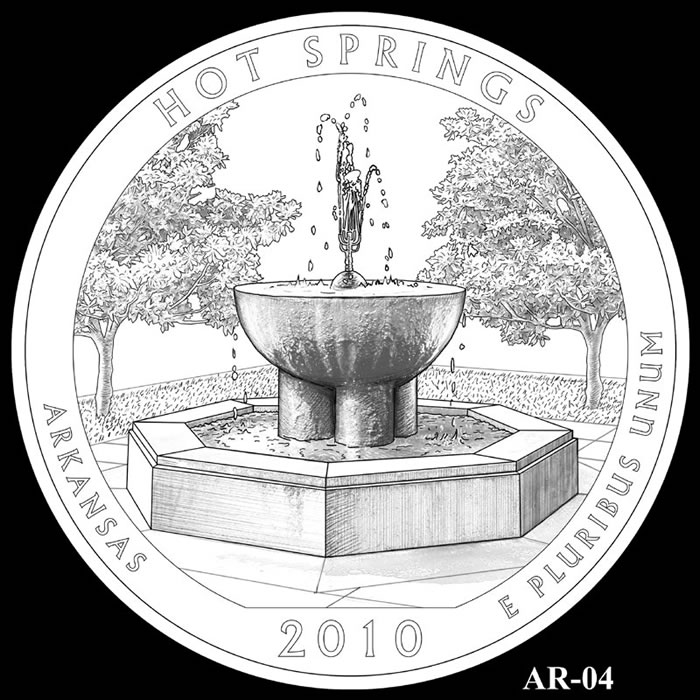
The Citizens Coinage Advisory Committee chose AR-04 as their favorite. It shows a fountain as well, but with trees and grass as a backdrop. Committee members appreciated the fact that the water was central to the design element.
The obverse or heads side of each quarter-dollar remains unchanged, depicting George Washington.
Hot Springs National Park Information
Utilized for centuries by Native Americans who called it the ‘Valley of the Vapors’, the area received little attention for years even after being ‘discovered’ by the explorer Hernando DeSoto in the 1500’s.
Both France and Spain claimed ownership of the area at one time or another until France ceded the land to the United States as part of the Louisiana Purchase in 1803. Over the next few decades, the Hot Springs area slowly gained in popularity to the point that the Arkansas Territorial Legislature requested that the US government set aside the land as a reservation to help protect it.
This protection as a reservation area occurred in 1832, making it the first land set aside by the government for the public’s use. Unfortunately, this designation did little to stop the exploitation of the resources and many of the hot springs were diverted into private bathhouses.
Finally, in 1877, the US Government initiated steps to preserve the area for future generations by assuming control of the springs. It still allowed private bathhouses to use the water, but controlled the flow with a government run plumbing system.
In 1921, Congress changed the name of the area to Hot Springs National Park and continues to oversee the use of the resources even today.